
How Much Freshwater CARICOM Actually Uses
Most members sit far below the level the UN counts as water stress
Water stress measures how much of a country’s renewable freshwater is withdrawn each year for farming, industry and everyday use. A higher share signals sharper competition for a finite supply. The United Nations treats any level above 25% as the point where stress begins.
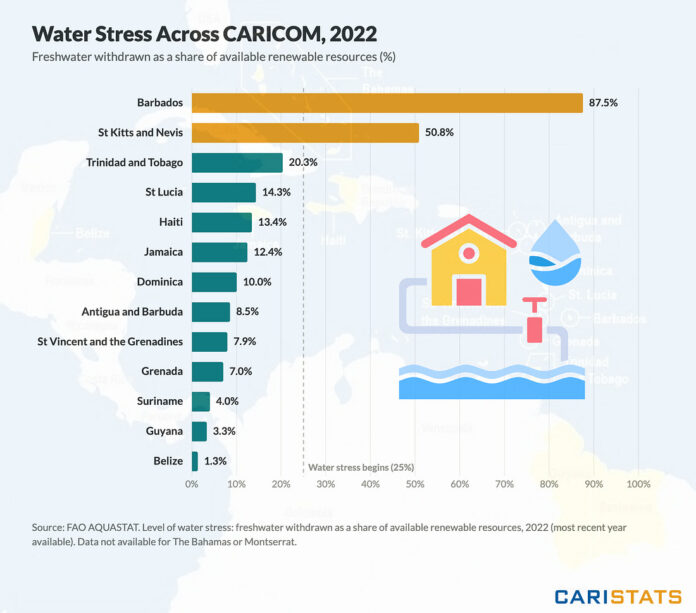
In 2022, the most recent year its water-monitoring programme was published, most CARICOM members sat comfortably below that line. Belize, Guyana and Suriname each drew under 4% of their renewable freshwater. Jamaica, Haiti and Trinidad and Tobago stayed within the no-stress band, the last of these at 20.3%.
Two members sit apart. Barbados withdrew 87.5% of its renewable freshwater, placing it in the high-stress category. St Kitts and Nevis drew 50.8%. Both are among the region’s smaller islands, drawing on a more limited resource base.
The split falls between land and water. The members drawing the least hold large territories and abundant rivers. Barbados, a flat coral island with no surface rivers, leans on groundwater, so its withdrawals claim most of what it has.
Source: FAO AQUASTAT. Freshwater withdrawn as a share of a country’s available renewable resources. National reporting runs on a multi-year cycle, so figures appear two to three years after their reference year. That makes 2022 the most recent available. Data not available for The Bahamas or Montserrat.
Source: Antigua News Room Antigua and Barbuda Among CARICOM Countries Below U.N. Water-Stress Threshold.