
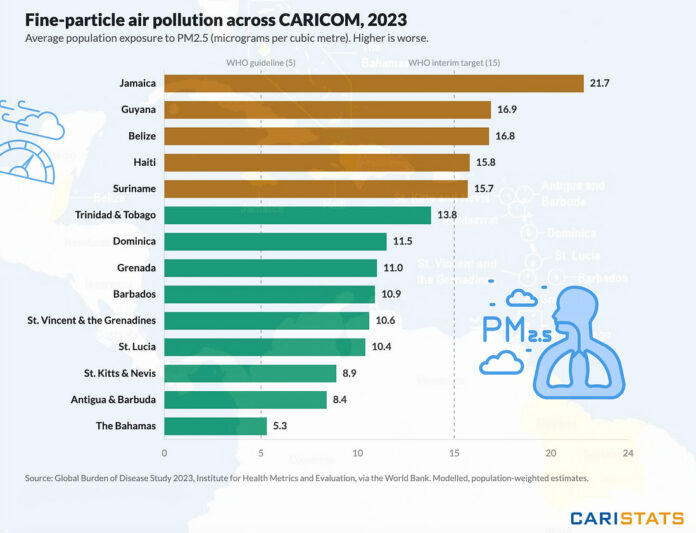

Air Pollution Across CARICOM Ranges From 5 to 22 Micrograms Per Cubic Metre
2023 estimates place the region at the low-to-middle of the global range, though none meet the strictest air-quality guideline
The Global Burden of Disease study, produced by the Institute for Health Metrics and Evaluation, estimates each country’s average population exposure to PM2.5 – fine airborne particles small enough to enter the lungs and bloodstream.
Across the 14 CARICOM members with data, 2023 exposure ranged from 5.3 micrograms per cubic metre in The Bahamas to 21.7 in Jamaica.
The pattern tracks geography more than income.
The lowest readings belong to small, ocean-surrounded islands – The Bahamas, Antigua and Barbuda at 8.4, and Saint Kitts and Nevis at 8.9 – where steady trade winds disperse particulates.
Higher readings cluster among the larger land masses and mainland economies: Guyana at 16.9, Belize at 16.8 and Suriname at 15.7, where agricultural burning, land clearing and industry add to the load.
The remaining islands mostly fall in between.
By global standards these levels are moderate; the world’s most polluted countries exceed 60 micrograms. Even so, every member sits above the World Health Organization’s guideline of 5 micrograms per cubic metre.
Source note: PM2.5 mean annual exposure, 2023, from the Global Burden of Disease Study 2023, Institute for Health Metrics and Evaluation, via the World Bank. Figures are modelled, population-weighted estimates.
Source: Antigua News Room Antigua and Barbuda Among CARICOM's Least Air-Polluted Countries.