



























































A leading Caribbean constitutional law expert has called for deeper regional ownership of legal and political institutions, describing the Caribbean Court of Justice (CCJ) as a central pillar of self-governance and identity.
Delivering the Norman Manley Distinguished Lecture in Kingston, Jamaica, Professor Tracy Robinson said the CCJ represents not only a legal forum but also a reflection of the Caribbean’s post-independence aspirations.
“Despite the diversity of our experiences, the CCJ is ours,” she said, noting the court’s 20th anniversary. “It is no longer an idea under construction—it is a functioning institution that mirrors the Caribbean’s legal maturity and plural identity.”
Professor Robinson, who teaches at the University of the West Indies, Mona, Faculty of Law, argued that reliance on the UK’s Judicial Committee of the Privy Council as the region’s final court of appeal is no longer appropriate.
She said continued loyalty to external institutions reflects what Barbadian writer George Lamming once described as “the terror of the mind”—a lingering doubt in the Caribbean’s own capacities.
Only five CARICOM countries—Barbados, Guyana, Belize, Dominica and St Lucia—have adopted the CCJ in its appellate jurisdiction. Other states continue to send their final legal appeals to London.
Professor Robinson framed the court as part of a broader effort to decolonise Caribbean legal education and jurisprudence.
She highlighted decisions from the CCJ that have addressed constitutional reform, electoral integrity, and outdated colonial laws—particularly those shielded by “savings clauses,” which prevent judicial review of laws passed before independence.
In her view, the court’s approach to interpreting these laws shows a commitment to regional self-determination. “The CCJ treats with suspicion the overwhelming impact on the dignity of Caribbean people of laws which were not made by the same people to whom they apply,” she said.
Robinson also argued that the court has contributed to the development of a Caribbean democratic culture, where public dialogue, accountability and constitutional values take precedence over imported legal traditions.
She questioned the continued emphasis on the UK’s Westminster model, stating that Caribbean constitutions must be understood on their own terms.
“The unpoetic truth is that saying we have durable Westminster constitutions that generate regular elections leaves us wholly unresourced to address the cacophony of democratic dysfunctions we experience,” she said.
The lecture included references to CCJ judgments concerning the right to vote, electoral disputes in Guyana, and media freedom. Robinson said these rulings illustrate the court’s role in safeguarding democratic principles in politically fragile contexts.
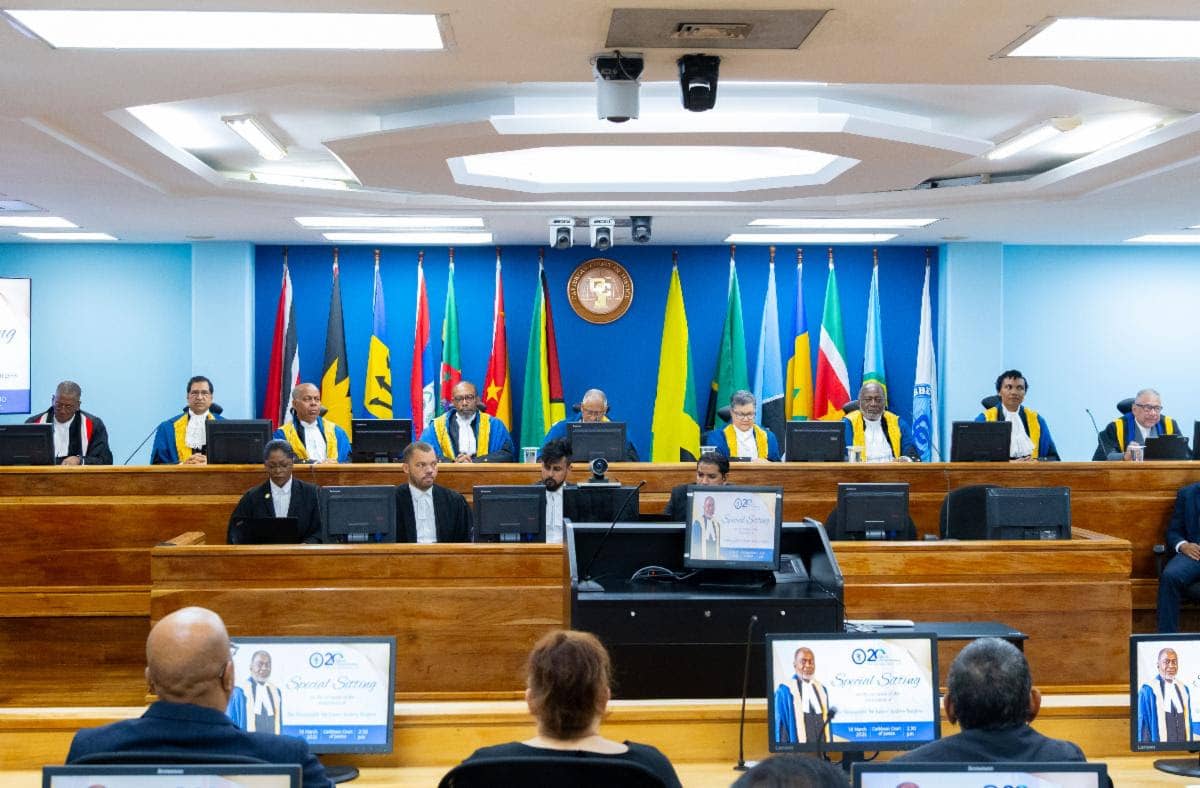
Robinson’s lecture coincided with a year of planned academic activities celebrating the court’s 20th anniversary, including research publications, case studies and student-led forums at the Norman Manley Law School.
Her address concluded with a call for renewed regional commitment to the CCJ and a broader cultural shift toward recognising Caribbean legal institutions as both competent and legitimate.
“This is not only about law,” she said. “It is about who we believe ourselves to be.”